Most food truck owners pour everything into the food. The recipes, the sourcing, the equipment, the permits. And that makes sense. You want the product to be great.
But here is the thing: amazing food does not matter if nobody knows you exist. Food truck marketing is not something you get around to later. It is the thing that determines whether your truck becomes a local favorite or just another business that quietly closes after 18 months. The U.S. food truck industry has grown into a roughly $2.8 billion market with over 92,000 businesses competing for attention, according to IBISWorld’s 2025 industry analysis. That is a lot of trucks. Standing out requires more than a great menu.
The good news? The six strategies below cost almost nothing to start. They just require a plan and the discipline to follow through. Here is what we are going to cover:
- Collect emails from day one so you own your audience instead of renting it from social media algorithms
- Use QR codes everywhere to connect physical customers to your social profiles, email list, and retargeting pixels for paid ads
- Post content on a consistent schedule using the 80/20 rule to build awareness without burning out
- Encourage customer photos to create free viral marketing and social proof
- Ask for reviews and respond to every single one to build trust and show up in local search results
- Email a press release to local media and food blogs to get free coverage that would cost thousands in advertising
Now let me break each one down.
Why Should You Start Collecting Emails on Day One?
This one surprises people. You are running a food truck, not an ecommerce store. Why would you need an email list?
Because email is the only marketing channel you actually own. Social media algorithms change constantly. Your Instagram reach can drop by half overnight and there is nothing you can do about it. But an email list? That is yours. Nobody can take it away or throttle your reach.
Here is how powerful this is for food businesses specifically: according to MailerLite’s 2025 benchmarks, restaurant industry emails see an average open rate of about 43.6%. That is significantly higher than most industries. Your customers actually want to hear from you.
And the data gets even more convincing. Research from MailMunch shows that if you have 2,000 email subscribers and 2,000 Facebook followers, roughly 435 people will open your email while only about 120 of those Facebook fans will ever see your post. Email is not just slightly better. It is dramatically better at reaching people who already like what you do.
How to start collecting emails right now:
Put a simple signup sheet on your counter. Use a tablet with a free Mailchimp account (their free tier handles up to 500 contacts). Offer a small incentive like a free drink or side item for signing up. The key is to start on your very first day of business. Every customer who walks away without giving you their email is a customer you might never reach again.
Once you have even a small list, send a weekly email with your schedule, any new menu items, and the occasional special offer for subscribers only. Keep it short. Keep it useful. That is it.
How Do QR Codes Turn Every Customer Into a Marketing Opportunity?
QR codes had a massive comeback during the pandemic, and they are not going anywhere. According to PYMNTS research, restaurant QR code adoption has increased by 150% across the United States in just two years. For food trucks specifically, QR codes solve a problem that no other tool can: they turn a physical interaction into a digital connection.
Here is what I mean. A customer walks up to your truck, orders a taco, and walks away. Without a QR code strategy, that interaction is over. You have no way to follow up, retarget, or remind them you exist.
But stick a QR code on your truck, your menu board, your napkin holders, and your packaging, and suddenly every touchpoint becomes a gateway. That QR code can link to your social media profiles, your email signup, your online menu, or even a special offer page. And here is the part most food truck owners miss: when someone scans a QR code that leads to your website, you can install a tracking pixel from Facebook or Google on that page. Now you can show that person targeted ads later for just a few dollars a day.
Set up QR codes that link to:
Your Instagram and TikTok profiles so customers can follow you instantly. A simple landing page where they can join your email list. Your Google Business Profile review page (more on that in a minute). A digital menu they can browse while waiting in line, which also reduces crowding.
Tools like QR Code Generator let you create dynamic QR codes that you can update without reprinting. That means you can change the destination from your menu to a seasonal promotion without making new signage. One restaurant using QR code ordering reported a 20% increase in average order size simply because customers could browse the full menu on their phones.
What Does a Real Food Truck Content Strategy Look Like?
About 68% of food truck owners already use social media as part of their marketing, according to recent industry data. But most of them are doing it wrong. They post when they feel like it, share a random food photo here and there, and wonder why it is not working.
Food truck marketing on social media requires consistency, not perfection. The 80/20 rule works well here: 80% of your content should be entertaining or engaging (food shots, behind the scenes videos, customer reactions), and 20% should be promotional (your schedule, your location, a special deal).
Here is a simple weekly posting schedule that works:
Monday: Share your weekly schedule with locations and times. Tuesday: Post a short video of food being prepared. Wednesday: Share a customer photo or review. Thursday: Tease a special or limited menu item for the weekend. Friday: Go live or post a story from your location. Saturday and Sunday: Share real time content from wherever you are set up.
The platforms that matter most right now are Instagram and TikTok. Data from Global Market Insights shows that about 87% of food truck operators maintain a Facebook presence and over 71% are active on Instagram. But TikTok is where the explosive growth is happening, especially with the millennial and Gen Z customers who make up the majority of food truck buyers.
Short vertical videos perform best. Film your food being assembled, capture the sizzle and steam, show the line of people waiting. You do not need a professional camera. Your phone is fine. What matters is that you show up consistently so people start to recognize your brand.
Read: 5 Types Of Food Truck Social Media
How Can Customer Photos Create Free Viral Marketing
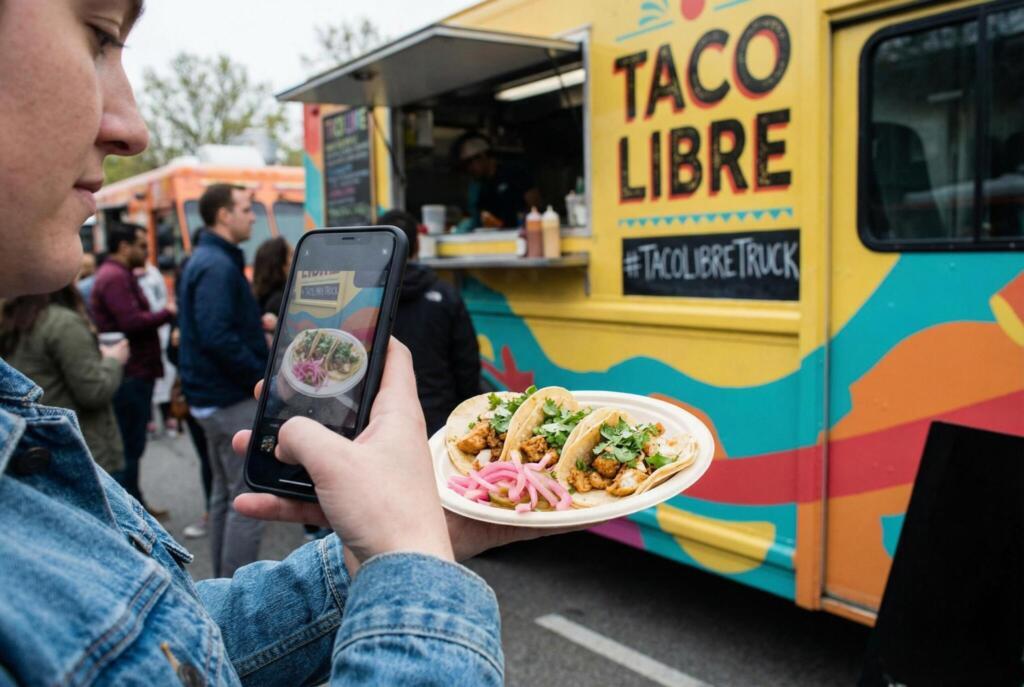
This is often overlooked, but it might be the most powerful food truck marketing tactic on this list. When a customer takes a photo of your food and shares it on social media, that is word of mouth marketing at scale. And it costs you absolutely nothing.
The key is to make your food and your truck photographable. Think about the visual presentation of your dishes. Think about the design of your truck. Think about creating a moment that people want to capture and share. A neon sign on your truck with a catchy phrase. A signature dish that looks as good as it tastes. A unique serving container or wrapper with your branding on it.
Then actively encourage it. Put up a small sign that says something like “Snap a pic? Tag us @yourtruck for a chance to win a free meal next week.” Mention it when you hand over the food. Create a branded hashtag and display it prominently.
When customers share photos, engage with every single one. Like it, comment on it, repost it to your stories. This does two things: it makes that customer feel seen (so they will do it again), and it shows their followers that real people love your food. According to BrightLocal’s consumer research, about 70% of customers research food businesses online before visiting. Those customer photos become social proof that attracts new customers without you spending a dime on advertising.
If you really want to accelerate this, run a monthly contest. The best tagged photo wins a free meal or a gift card. It creates a cycle where customers are essentially doing your marketing for you.
Why Are Reviews the Most Underused Growth Tool for Food Trucks?

Let me give you a number that should get your attention. BrightLocal’s 2026 Local Consumer Review Survey found that 68% of consumers will only use a business with four or more stars, up from 55% just a year earlier. And 41% of consumers now say they always read reviews before choosing where to eat. Always.
For food trucks, reviews are even more critical than they are for traditional restaurants. Why? Because a brick and mortar restaurant has a permanent sign, a physical location people drive past, and years of built up awareness. Your truck moves. People need a reason to seek you out, and reviews provide that reason.
Here is how to build your review presence:
Set up your Google Business Profile immediately. This is free and it is how you show up when people search “food trucks near me.” Then create a QR code (see above) that links directly to your Google review page and place it near your payment area.
Ask for reviews at the point of sale. It does not have to be awkward. A simple “If you enjoyed the food, we would really appreciate a Google review. It helps us a lot as a small business” works perfectly. Most people are happy to help if you just ask.
But here is where most food truck owners stop, and it is a mistake: you also need to respond to every review. Every single one. BrightLocal’s research shows that 19% of consumers now expect a response to their review on the same day they post it, and 81% expect a response within a week. When you respond to reviews, positive or negative, you show potential customers that there is a real person behind the business who cares about the experience.
For negative reviews, do not get defensive. Thank them for the feedback, acknowledge the issue, and explain what you are doing to fix it. I have seen businesses turn one star reviewers into loyal repeat customers just by handling the response with grace.
How Does One Press Release Get Your Food Truck in Front of Thousands?
This is the strategy that almost nobody in the food truck space is using, which is exactly why it works so well. Local media outlets, food blogs, lifestyle magazines, and community news sites are constantly looking for stories. A new food truck opening in town is exactly the kind of story they want to tell.
Writing a press release is not as intimidating as it sounds. According to Mobile Cuisine Magazine, a food truck press release just needs to cover the basics: who you are, what makes your food special, when and where people can find you, and a quote from you that adds a personal touch. Keep it under five paragraphs. Include one or two high quality photos of your food and your truck.
Where to send your press release:
Local newspapers and their food or lifestyle sections. Regional food blogs (search “[your city] food blog” and you will find them). Local TV station websites that have community event sections. Neighborhood Facebook groups and community forums. Platforms like Eater and Edible, which have outlets in many major cities.
You might be surprised by who picks it up. One food truck owner who published a press release about their launch got covered by the local paper, a niche food industry magazine, and caught the attention of food bloggers who came out to review the truck. That kind of earned media coverage would cost thousands of dollars if you had to pay for it.
Send your press release two to three weeks before your launch or a major event. Then follow up with a polite email a few days later. Offer to let reporters come by for a free tasting. Local journalists love covering new food businesses because their audiences love reading about them.
And do not treat this as a one time thing. Any time you have news, whether that is a new menu launch, a charity partnership, a milestone like your one year anniversary, or a special event, send out another release. Each one is another opportunity for free publicity.
What Separates the Food Trucks That Survive From the Ones That Close?
About 60% of food trucks fail within three years, which is roughly the same failure rate as traditional restaurants. But the ones that make it tend to have something in common: they started marketing before they started cooking.
Food truck marketing from day one is what separates the trucks that survive from the ones that close. It is not about having a massive budget. The six strategies above, collecting emails, using QR codes strategically, posting content consistently, encouraging customer photos, building up reviews, and getting press coverage, cost almost nothing to implement. They just require showing up and doing the work every single day.
Start with the one that feels most doable. For most people, that is setting up your email list and your Google Business Profile. Once those are in place, layer in the rest. Build the habit of asking for reviews, posting content on a schedule, and reaching out to local media whenever you have something newsworthy to share.
Your food might be the best thing on four wheels. But the world will not find out unless you tell them. Start telling them today.